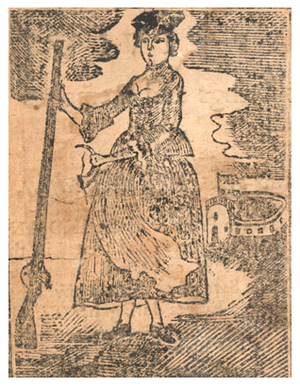
Mary Rowlandson’s story of captivity among the Native American’s is a really interesting story, because it gives us a first hand look into how Native American’s lived at the time. Although it is quite a skewed perspective since it is told through a hostage’s point of view, it is still a valuable piece of literature. Especially to see how resourceful the Native Americans were. She noted how the English burned all their corn crops, thinking that would starve them for good, even burning all their extra supplies. Quickly she saw they would eat many things on the ground, like nuts, acorns, and artichokes. Although that does not seem strange to us now, the things that were obscure were how they would eat horses’ guts and ears, beavers, squirrels, dogs, and even barks of trees. These were a people who were determined to survive no matter what.
I found that when I first started reading the text, I was a little annoyed with Mary Rowlandson. I knew the terrible things to come to the Native American people, so I sort of thought some of these English people were getting their due justice by the Indians. But the fact that in the midst of everything, she kept praising God and seeing his divine plan was remarkable to me. I expected her retelling to be a complete complaint of how barbaric the Indians were, but she seemed to be more concerned with showing how God was working with her and the people the entire time she was a captive. The most notable quote I found was on the top of page 127 which says, “they made use of their tyrannical power whilst they had it; but through the Lord’s wonderful mercy, their time was now short”. She shines the Indians in a negative light, while uplifting God at the same time.
I know in class when we talked about the poems where all the strife was occurring and Anne was able to have faith through it all, we all struggled to think she really could see the light in the continuing storms. Mary Rowlandson is the proof these people were not just saying what they were taught to, but living a life for their religion. One of her concluding thoughts in her memoir were “if smaller matters begin to arise in me, I have something at hand to check myself with, and say, why am I troubled?”. She knows she survived something awful and only has God to thank for that. I do not think many other survivors would have the same mindset. It really resonated with me and made me sad to think I have complained at much more trivial of matters.


Your final sentence is very comparable to the emotions the narrative evoked in me as well. Every human is capable of unbreakable and unflappable faith and strength, no matter what form or fashion, but in the end it all depends on how and when we use it. Many situations occur in life that enable us to take a step back and say "I am blessed, it truly could be worse."
ReplyDeleteHi Sara, Thanks for posting on Rowlandson. I really like the engraving you included. Rowlandson never carried a weapon, but that did not stop the engraver. The text is a fascinating look at both the Native Americans and the Puritans, but we have to keep in mind it was published six years after the events and that the narrator is a character. dw
ReplyDelete